

Past events
Dharug/Bankstown 2025
Therapeutic Life Story Work Symposium
Connecting Practice, People, Purpose, and Community
TLSW Australia were honoured to hold our 2nd National Symposium, this year in Bankstown, New South Wales.
We are deeply grateful to Settlement Services International (SSI) for providing such a welcoming and inspiring space for this gathering, and want to thank each of our wonderful presenters, attendees and members involved in these amazing few days.
This was truly a demonstration of the hard work, patience, passion and commitment that exists within the TLSWa Community of Practice. Together, we are weaving a stronger, more connected future for TLSW across Australia.
For those that could join us, Yarning with Aunty Glendra on Dharug Country Sunday 16th November was how we set the scene. The wonderful Nada Aldobasic guided the group through learning to do traditional weaving, while Aunty Glendra yarned with us about TLSW.
This created a welcoming, safe and grounding space where we were able to reflect on our work and the potential positive impacts it can have on our communities. It was a fantastic opportunity to connect, learn, and grow with a community dedicated to making a difference, followed by a 2-day program filled with creativity and shared purpose.


Day 1
Beginning with a powerful Welcome to Country by Aunty Gail Smith that grounded us in the spirit of the land and its people. Day One set the tone for rich in stories, wisdom, and connection.
Professor Richard Rose’s keynote, The Heart of the Story, reminded us of storytelling’s transformative power in healing, while Elise Saunders’ Walking Together keynote emphasised growth through collaboration, diversity, and shared purpose.
Tina McGhie’s session, Grounding in Wisdom: A First Nations Experience, offered profound insights into the resilience of First Nations practices and their relevance to TLSW.
Soula Kontomichalos followed with Stories That Shape TLSW Research, highlighting the importance of evidence-based practice.
A heartfelt lived-experience conversation, Through the Eyes of Care, shared Natasha’s journey as a caring adult in the TLSW triad, with Amy Payne offering a raw perspective on resilience and humanity.
Jodie Mollison’s workshop, All About You, provided practical tools for inclusive and adaptable approaches to TLSW.
The day concluded with Forest of Trees, with Kayla Curtis and Senada Aldobasic sharing both a too; and also symbolic exercise weaving together the day’s themes of growth, resilience, and community.
Day 2
Anna Kirby and Simone Flavelle presented Disability and Belonging: My Place WA Ltd and Centre for Stories, Western Australia, a powerful exploration of inclusion and storytelling.
Insights from Meisha and Tameka reminded us of the transformative Power of Play in therapeutic work.
Natalie B’s presentation, Stories of Change and Integration of TLSW into the Criminal Justice System, was a compelling look at how TLSW is making a difference in the lives of young people.
Zena and Habiba from SSI shared Multicultural Approaches to TLSW, highlighting the importance of cultural sensitivity and inclusivity.
Kayla facilitated a thought-provoking discussion with Renee, Natasha, Debbie and Nickie on advocacy and purpose in TLSW practice.
Rachel and Maria Angelica Bolla offered valuable insights for integrating psychoeducation into TLSW.
Finally, Amy and karen led a hands-on session exploring the River of Resilience, showcasing tools for TLSW practice.
As we reflected on the day with Elise, we were reminded of the power of community, creativity, and shared purpose.


Richard's farewell to Australia tour
In May and June 2025, Australia said their heartfelt farewell to Richard as he made his final visit after 17 years of in-person training that has profoundly shaped the therapeutic community.
From Western Australia, South Australia, NSW, ACT, Queensland, Tasmania, Northern Territory, to Victoria, the practitioners' words to him spoke of his expertise and teaching of TLSW and also reflected on the countless lives he has touched. His wisdom, generosity, and unwavering care have left an indelible mark on practitioners and clients alike, creating a legacy that will continue to inspire for years to come.
For those fortunate enough to gather in Naarm (Melbourne), the farewell was more than an event—it was a moment of deep connection and gratitude. Together, we celebrated Richard’s friendship, his ability to inspire, and the immense appreciation we hold for his leadership in TLSW. The day was filled with laughter, reflection, and even a final group game, embodying the spirit of community and joy that Richard has always fostered.

YouTube link to the farewell celebration
His presence has been a guiding light, and while this marks the end of an era, his teachings and the relationships he nurtured will continue to thrive by the TLSW Australia Community of Practice (kookaburras).
Thank you, Richard, for your care, wisdom, and the legacy you leave behind.
With our Australian community continuing to grow, Richard has entrusted our TLSWa committee of skilled practitioners, led by Elise, to continue to lead the way for TLSW practice, fidelity, and innovative growth within an Australian context. This ensures that many more children, young people, and adults will have the opportunity to engage in this valuable work.
Naarm/Melbourne 2023
The Story of our Therapaeutic Life Story Work Symposium
The Amora Hotel conference room buzzed as it filled with TLSW practitioners, students and people interested to learn more about TLSW in Australia. We were welcomed to Naarm country by Thane Garvey from the Wurundjeri Woi-wurrung Cultural Heritage Aboriginal Corporation who shared his story, setting the tone for 2 days of story sharing and connection from presenters, panelists and participants.
Keynote speaker Meena Singh, the Commissioner for Aboriginal Children and Young People in Victoria spoke to us about the importance of storytelling to First Nations communities and her work at the Commission. She also shared a little of her story as a Yorta Yorta and Indian woman, born and living on the land of the Kulin Nations. Meena said it is crucial to keep telling the stories of those with lived experience.

Richard Rose founder of the Rose Model of Therapeutic Life Story Work then spoke to us, sharing an example of wallpaper with the room (that we were not allowed to photograph). He spoke about monsters and ghosts, and how children have already experienced what we are sometimes cautious to share with them about their lives.
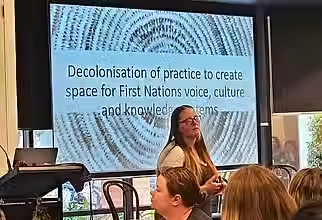
Nada Aldobasic, a Gunditjmara and Bosnian woman led us through activities and thinking that helped us think about the importance of decolonisation of practice to create space for First Nations voice, culture and knowledge systems. She invited us to use the Behaviour Tree as a tool to explore the experience of colonisation for First Nations people, which led to vigorous discussions around the room. Throughout the symposium Nada documented the presentations on wallpaper attached to the inside walls of the space.

We heard about current research findings from the “Therapeutic Life Story Work Barwon Pilot Evaluation”. Dr James Lucas from Deakin University talked us through how IT WORKS, demonstrating the evidence of the benefits of TLSW. Who would think that graphs could be so interesting. His co-collaborator MeishaTaumoefolau, was sadly unable to attend.

Dr Robyn Miller, the CEO of MacKillop Family Services then welcomed us to a networking event that MacKillop very generously sponsored, with far too much food and raucousness. Thanks MacKillop!

Our final activity for the symposium was Richard’s ‘Animal game’, which had us considering which animal our table mates reminded us of, and comparing their animals with our own imaginings for ourselves. Richard is not that cuddly bear so many of us think him to be, but rather sees himself as a wily Mr Fox.


Day 2
Day 2 opened with lived experience expert Lillian sharing her story along with her TLSW practitioner Amy Payne. This was the highlight of the symposium with Lillian’s enthusiasm for the process of adult TLSW shining through. Lillian shared her journey bravely and candidly, and said 'I never thought I would find myself the way I have’. Her 6 month old daughter networked throughout the auditorium during this presentation.

On the panel on ‘diversity in practice’ Tamara Bellamy shared stories of using ‘All About Mebooks’ with groups and how much the young people enjoyed and benefitted from the sharedgroup experience. Linda Cooke shared her story of piloting an ‘All About Me’ program in herschool, and after an incredibly positive response she will roll out the program to other classes.Linda found out about TLSW through a parents’ workshop, as she is an adoptive parent to anamazing 18-year-old, who is her biggest teacher.
The benefit of using Adult Attachment interviews in TLSW was explained to us by RachelNapier and Liz Sanders. Knowing a person’s attachment style helps build engagement andidentifies potential obstacles at different stages in the TLSW process. For the parent/carer itenhances their self awareness and their understanding of barriers in their relationships.
Jodie Mollison and Tameka Willis talked to us about Program Frameworks, with Tameka telling her story of implementing a fee-for-service TLSW program at Berry Street, after receiving a one-off philanthropic grant. Jodie spoke about using TLSW tools to work therapeutically in the residential space, and about leading the implementation of the 3 tier model of TLSW in MacKillop Family Services in NSW.

Following this Amy Payne shared with us the development of using TLSW to work with adults. This is an adaption of the Rose model, in which the TLSW practitioner is not the sharer of information, rather the witness and ‘holder’, supporting the adult client to uncover and explore the parts of themselves to understand and be able to grow through the story of their life (so far).
After lunch Renee Coiner shared her re-imagining of the Behaviour Tree, using a sprouting seed over time to explore with a child how development and experience is influenced by their environment. Then Karen Vance spoke about Cultural Consciousness in Practice from her experience working in the multicultural sector. She gave some practice time using a tool called the Addressing framework (Hayes) to think about Intersectional intersubjectivity in our TLSW practice.
Kayla Curtis spoke of her own story and shared tools for working with people adopted internationally. Working with both children and adults she said that TLSW goes beyond simply creating a life story book, it empowers the adopted person to play an active role in constructing and making sense of their stories, at any stage of their life.

After lunch we had our first presentation from a lived experience expert, Dorcasse who said that her caseworker Kerry Connolly ‘didn’t just hear me, she listened to all that I said and what I needed’. Meeting Dorcasse reminded us of the importance of knowing that the lived experience experts are who we need to listen to.
Next we heard from a panel of experts in their fields on how TLSW can have an impact on healing, and restorative justice. Professor Richard Rose was joined by Liana Buchanan, Principal Commissioner for Children and Young People, Dr Robyn Miller, CEO MacKillop Family Services, Annette Jackson, Executive Director, Berry Street and Soula Kontomichalos, General Manager Youth Justice & Children’s Court Youth Diversion. They spoke of their involvement in working with children and young people and how they saw that TLSW could be beneficial to them.
As we walked past Nada’s wallpaper rendition of our shared symposium experience we reflected on the stories we’d heard, the connections we’d made, the inspiration of new ideas for our practice, and agreed it had all ended much too quickly.
Thanks to the amazing team that put this inaugural TLSWa symposium together. Especially thanking Elise Saunders, the chair of TLSWa who with great passion and skill acted as MC through the symposium sharing her story and leading us along this journey.

